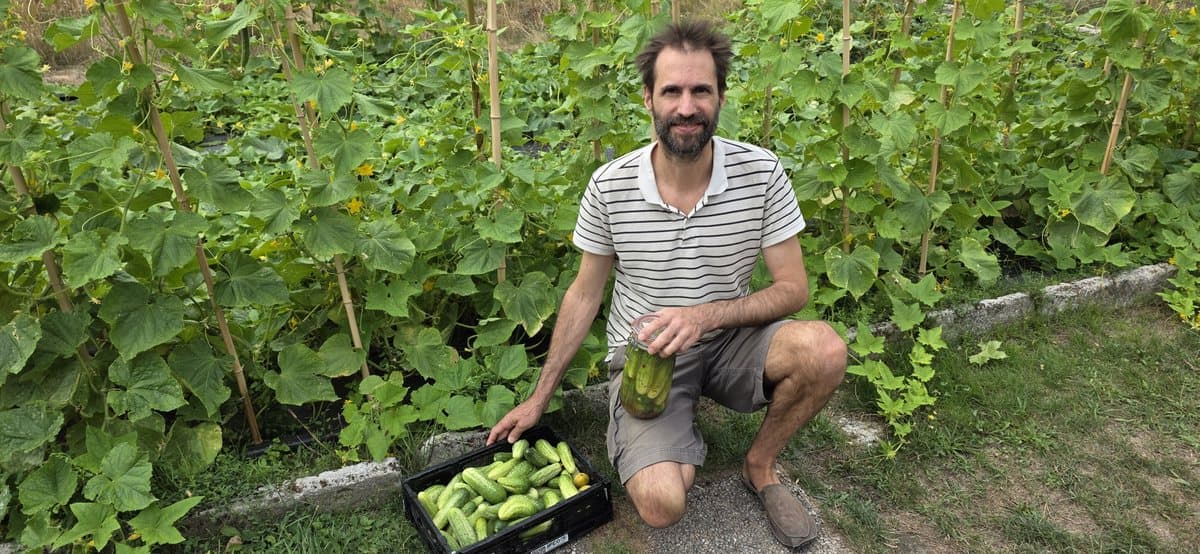
It began in my garden in Champagne, Switzerland, with a project I had been turning over for a long time: fermenting cucumbers in the Balkan tradition. In the heat of summer, things moved quickly. I planted the cucumbers around the solstice, watched them germinate and planned a research trip east. In mid-July, just before I left for Poland, the plants were barely 30 centimetres tall. Three weeks later, on the day I returned, the harvest began.
A journey through different ways of eating cucumbers
Along the way, I met growers and makers who have worked with cucumbers for years. I took a detour through the Spreewald, a region known for its Spreewälder Gurken. Their methods taught me that “pickle” does not describe one single technique. I tasted lightly salted seasonal cucumbers with plenty of crunch, alongside winter preparations made with more salt for longer keeping and a softer bite.
Where does “pickle” come from?
The English word probably comes from Middle Dutch pekel, meaning brine. It first referred to the liquid rather than the cucumber. For me, that is a lovely way into what happens in the jar: lactic acid bacteria gradually acidify the brine. Etymology source: American Heritage Dictionary.
Those encounters gave me a wider picture of what lactic acid fermentation means in these places. Our article on fermented food traditions around the world takes that journey further.
Back in Champagne, the garden set the pace. Every day I searched beneath the leaves for hidden cucumbers and filled the first barrels. Once I realised how much work this really involved, I looked for local growers to help us extend the harvest. Around Lucens, I found a promising connection.
What happens in the brine?
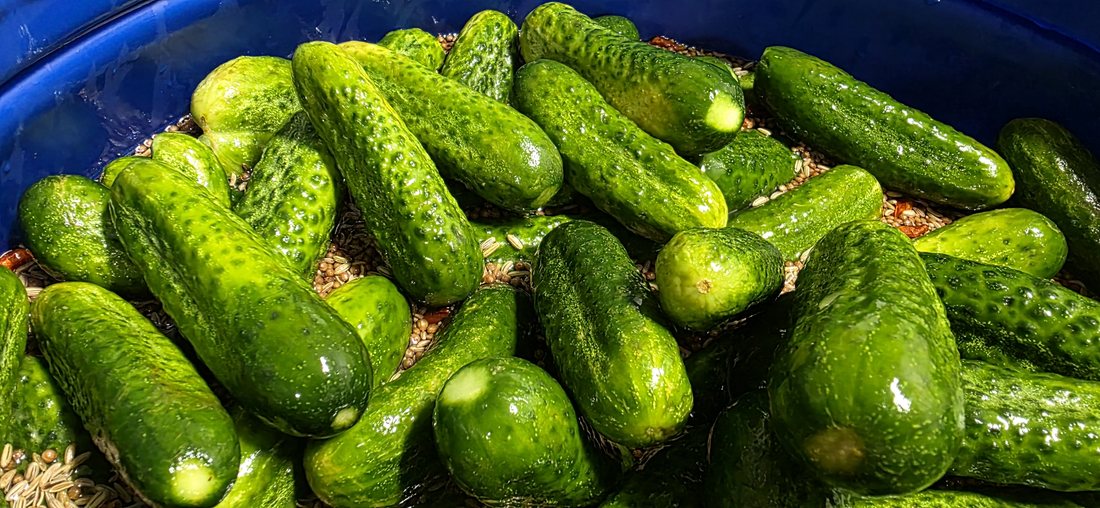
Our cucumbers go into brine made with water, salt and spices. During lactic acid fermentation, microorganisms turn some of the cucumber’s sugars into acids. This builds acidity and part of the flavour. It is different from simply adding vinegar to acidify a cucumber. The National Center for Home Food Preservation explains why salt levels matter for texture and safety.
We are still watching how our young cucumbers change over the months. We want to balance crunch, flavour, salt and keeping quality. That work is ongoing, so I will not announce a final salt level or a storage life we have not yet established.
Fermented cucumbers: a world of flavour
A fresh cucumber is mostly water and low in energy. With its skin, it also provides small amounts of fibre and micronutrients, including vitamin K and potassium. It is hardly a vitamin powerhouse; freshness, crunch and the pleasure of eating vegetables are part of its appeal. These facts describe the fresh cucumber, as outlined by the University of Illinois Extension.
In one of my trials, the cucumber was already crunchy, almost sparkling and surprisingly refreshing after five days. Over time, the acidity becomes more pronounced and the flesh softens.
As it matures, the colour and flavour become more even. It loses some firmness, yet remains a pleasure to eat: with raclette, it brings something quite different from a vinegar pickle. We cannot infer the finished product’s nutritional values from raw cucumber alone; the recipe and portion matter. Please check the jar label for salt content. We make no medical claim for fermentation here.
Cloudy brine: should we worry?
Fermented brine may become slightly cloudy, sometimes almost milky. Fermentation and fine suspended particles change its appearance; the German word naturtrüb means “naturally cloudy”. A pale deposit can have several causes. Colour, smell or taste alone cannot establish that a jar is safe. The NCHFP’s pickling FAQ lists several causes of cloudy brine. If the appearance or smell of one of our jars worries you, do not taste it: contact us.
Kahm yeast: on the surface, not in the brine
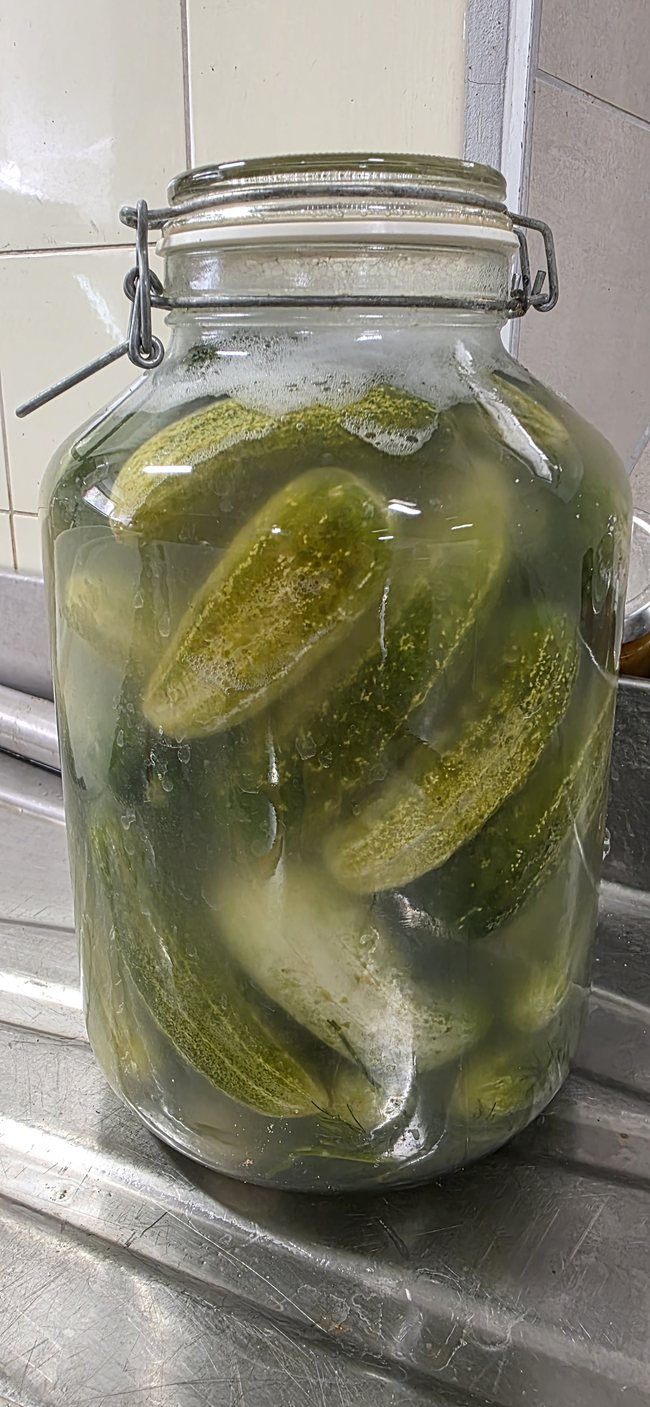
“Kahm yeast” is a common name for a yeast film that can form where brine meets air. It may look like a thin, pale, matte and sometimes wrinkled layer. This differs from cloudy brine: a film sits on the liquid, while cloudiness is in it.
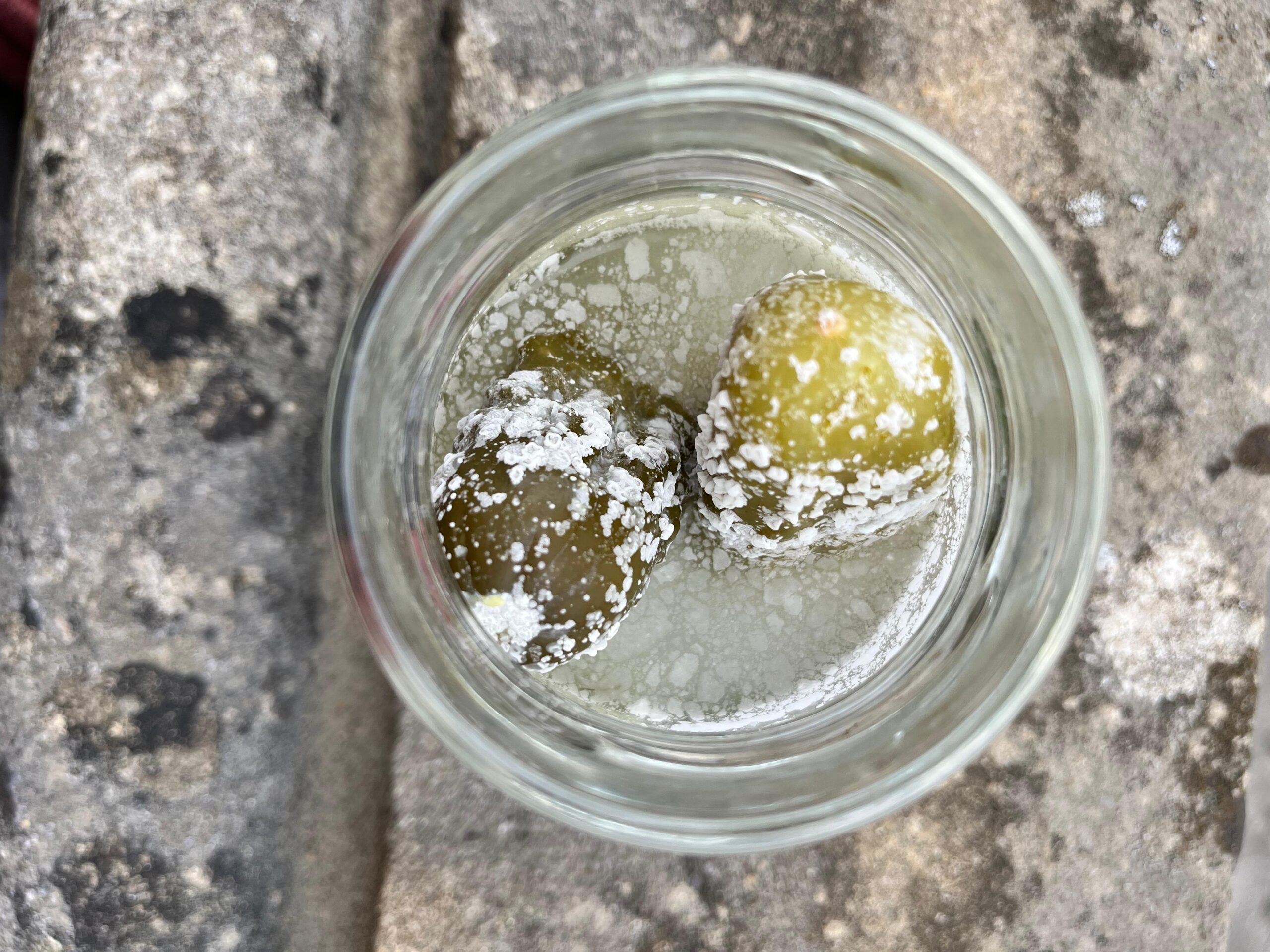
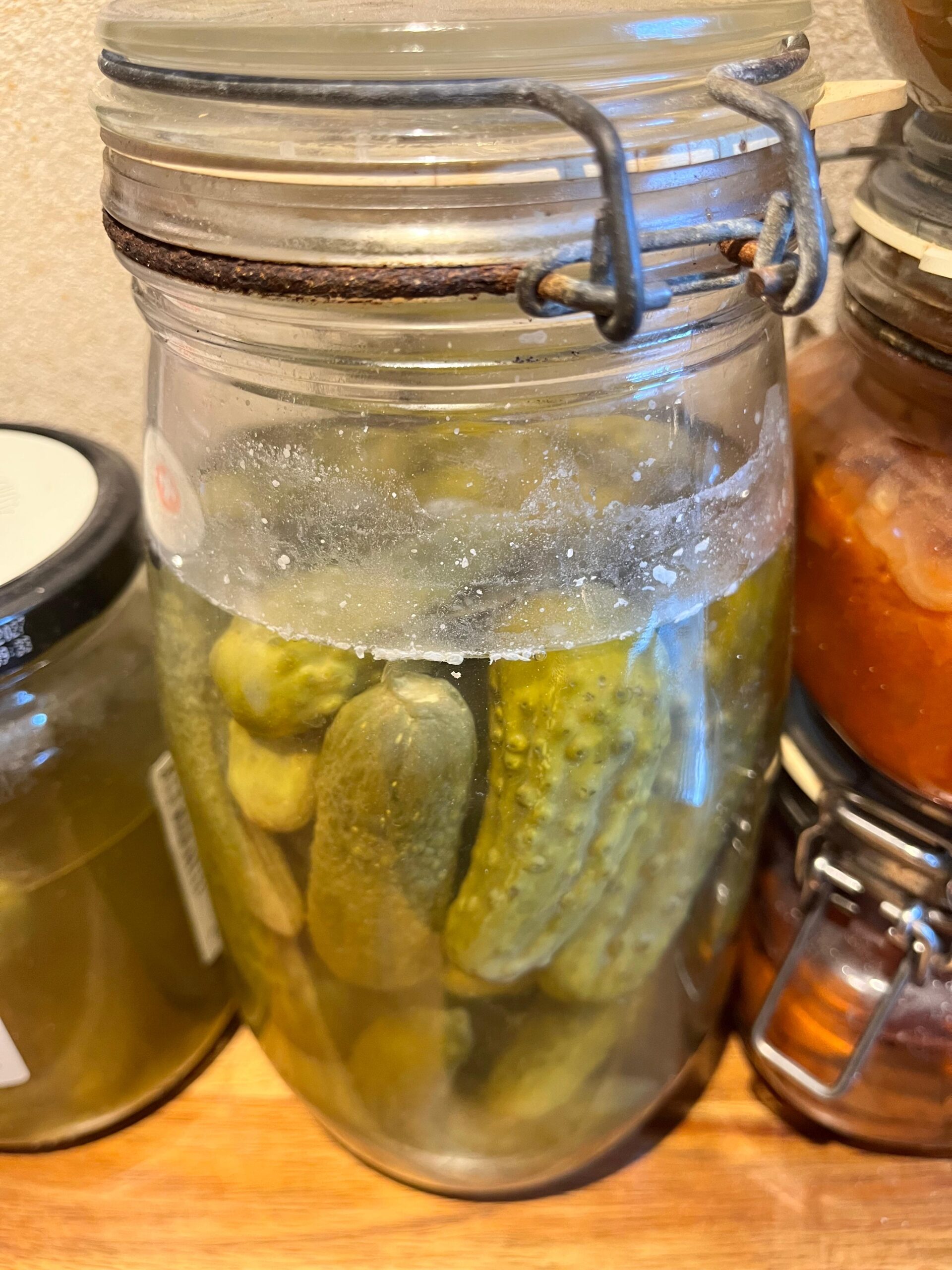
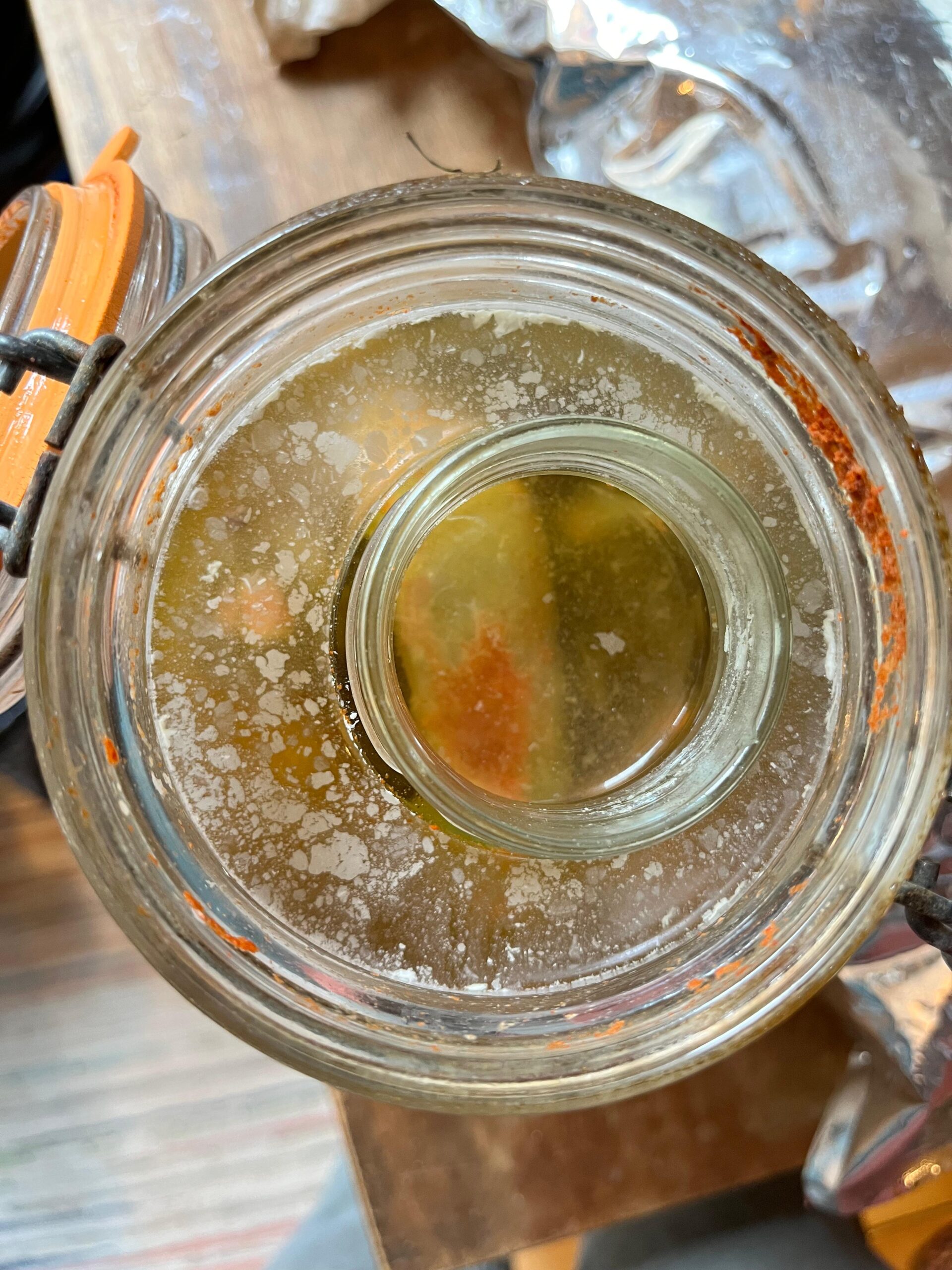
The German Federal Centre for Nutrition (BZfE) explains that a yeast film may form on fermenting vegetables and recommends removing it regularly because it can affect the flavour. Our photographs show different white deposits on cucumbers and their brine. They resemble what fermenters sometimes call “kahm”, but cannot identify the deposits with certainty. A jar’s history matters as much as its appearance.
What I look for when a white film appears
- Observe without jumping to a conclusion. A flat, pale surface film may suggest yeast; cloudy brine is a different phenomenon. Neither a picture nor a pleasant smell or taste guarantees that the contents are safe. If a jar concerns you, do not taste it.
- Limit contact with air. During a home ferment you have followed from the beginning, gently skim any surface film with a clean utensil and keep all the cucumbers below the brine. The French Chambers of Agriculture and INRAE guide stresses full immersion. Rinsing cannot make a doubtful jar safe.
- Know when to discard. If growth is fuzzy or coloured, smells rotten or the cucumbers are slimy, do not taste them; discard the home ferment.
- After opening. Keep the jar refrigerated and follow the period stated on its label. Brine from a jar with no worrying signs can season a sauce or a dish. If a deposit or smell concerns you, do not reuse the brine.
If a Fermentierra jar concerns you, keep it closed and contact us with a photograph and its batch number. We will review the case with you.
A basic recipe to try at home
A few small cucumbers, dill and brine show what time can do to flavour. This home recipe without vinegar draws on the Terre Vivante recipe and guidance from the German Federal Centre for Nutrition (BZfE). It is not the formula used in Fermentierra jars.
For a large, clean jar
- about 1 kg of small, fresh, firm cucumbers;
- water and 30 g salt per litre of water, or 9 g for 300 ml; make more brine at the same ratio if needed;
- a few sprigs of dill, 2–4 garlic cloves, one bay leaf and, if you like, mustard or coriander seeds.
Method
- Wash the cucumbers, remove damaged parts and cut a thin slice from the blossom end to help preserve their crunch.
- Put the aromatics and cucumbers in a clean jar. Dissolve the salt in water and pour in enough brine to cover the cucumbers completely.
- Keep them below the surface with a clean weight. Use a suitable fermentation lid that allows gas to escape, or follow the jar maker’s venting instructions.
- Leave to ferment for about a week at 20 °C, away from direct sun. Check daily that the cucumbers remain submerged, and observe the surface and smell. Timing varies with temperature and cucumber size.
- When you like the acidity and texture, move the jar to the fridge and keep the cucumbers under brine. The Terre Vivante recipe continues with a longer cool maturation.
Keep this home ferment refrigerated; it is not processed for storage at room temperature. If you see fuzzy or coloured mould, smell decay or find a slimy texture, do not taste it: discard the contents. The French Chambers of Agriculture and INRAE guide explains why brine control and full immersion matter.
How do we eat them?
I like to eat them as they are, with my fingers. Sliced, they also brighten a sandwich or an aperitif. Nature lets the fermented cucumber speak for itself; Hot adds garlic and chilli. You can find both versions in our shop.
This first season brought wonderful conversations and encouraging feedback. I will keep watching how the barrels develop and sharing what we learn. That is part of the pleasure of fermentation: getting to know the whole journey, from the first crisp bite to a more mature acidity, takes time. We are still refining the recipes and already look forward to next spring, when we can offer you these delicious fermented cucumbers again.